What is VWAP?
When looking at stock charts, you might encounter an indicator called VWAP.
VWAP isn't just a simple average price. It's an average price that incorporates trading volume. This makes it useful for understanding at which price levels market participants were most active during the trading day.
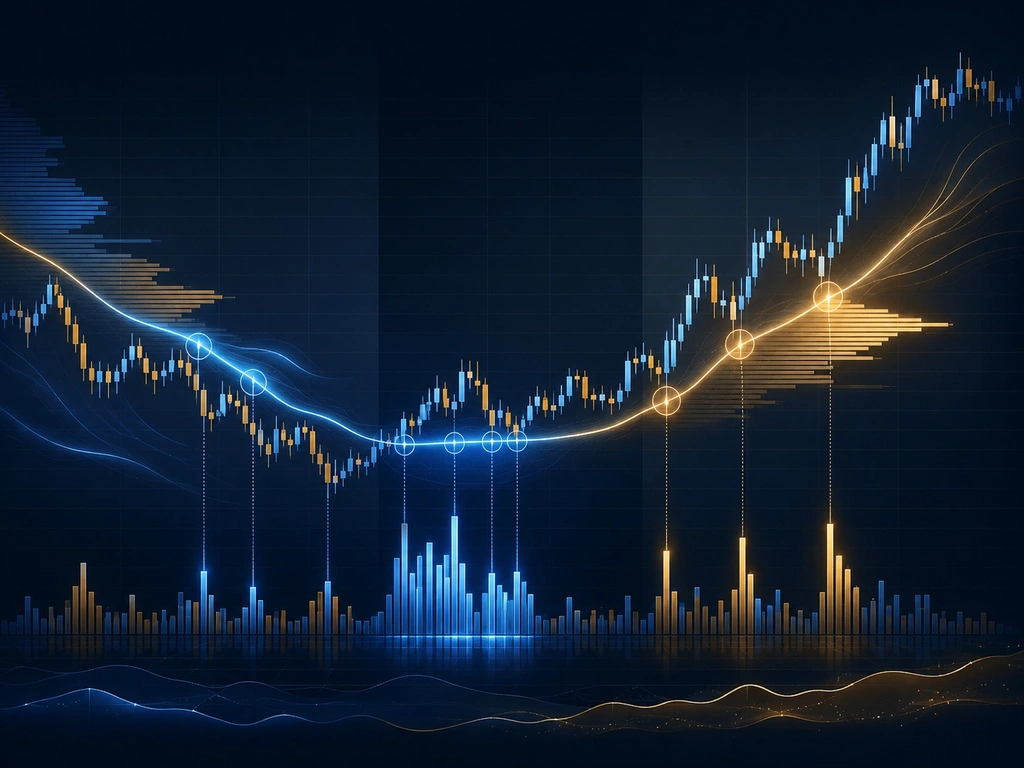
What VWAP Means
VWAP stands for Volume Weighted Average Price.
In English, it's commonly referred to as Volume Weighted Average Price.
As the name suggests, it's an average price calculated by factoring in trading volume.
VWAP = Average trading price reflecting volume
A simple average only considers price. However, VWAP also takes into account at what price and how much was traded.
For example, if there was little trading at $10,000 but significantly more at $10,200, the market's average price would be calculated closer to $10,200.
How VWAP is Calculated
The basic formula for VWAP is as follows:
VWAP = Cumulative (Price × Volume) / Cumulative Volume
Let's consider an example with the following trades:
| Price | Volume | Price × Volume |
|---|---|---|
| $10,000 | 100 shares | 1,000,000 |
| $10,100 | 200 shares | 2,020,000 |
| $10,200 | 700 shares | 7,140,000 |
The calculation is as follows:
Total Price × Volume = 10,160,000
Total Volume = 1,000 shares

VWAP = 10,160,000 / 1,000
     = $10,160
While the simple average would be $10,100, the VWAP is $10,160.
The average price was pulled higher because a significant amount of trading volume occurred near $10,200.
What Timeframe Does VWAP Cover?
VWAP is typically calculated by cumulatively tracking trades from the market open until the current moment on a given day.
This means that if a particular stock began trading at 9 AM today, VWAP continuously aggregates the executed prices and volumes from 9 AM until now.
Average price based on cumulative trades since today's market open
Consequently, VWAP constantly changes throughout the trading day. Early on, with lower volume, it can be more volatile, but as volume accumulates over time, it becomes a more stable reference point.
You don't need to calculate this value yourself. You can simply check the VWAP line provided on brokerage charts, HTS (Home Trading Systems), or MTS (Mobile Trading Systems).
What VWAP Signifies
VWAP can be seen as a benchmark that approximates the average purchase price for the market during the trading day.
If the current price is above VWAP, it suggests that the stock is trading at a higher level than the average transaction price during the day.
Current Price > VWAP
= Current price is above the intraday average trading price
Conversely, if the current price is below VWAP, it means it's trading at a lower level than the intraday average transaction price.
Current Price < VWAP
= Current price is below the intraday average trading price
This difference is significant.
If the current price moves above VWAP, it indicates that buyers are continuously accepting prices higher than the intraday average. This suggests that the market is forming a relatively strong trend.
If the current price moves below VWAP, it means it hasn't recovered above the intraday average trading price. This could imply weak buying pressure or continuous selling pressure from higher levels.
How to Use VWAP in Analysis
1. Identify the Current Price's Position
VWAP serves as a baseline for intraday prices.
Current price is above VWAP
= Stronger position than the intraday average

Current price is below VWAP
= Weaker position than the intraday average
This alone can quickly show whether the current trend is strong or weak.
2. Increase the Reliability of Breakout Signals
In stock charts, when the price breaks above a previous high, a breakout occurring above VWAP often appears as a stronger signal.
For example, consider the following scenario:
Current price is above VWAP
Increasing volume
Breakout above recent high
Bullish candle formation
In this case, it's not just a momentary price spike; it can be interpreted as buying pressure building up from a position stronger than the intraday average price.
Conversely, if the current price is below VWAP and only briefly touches a high, the momentum might be weak. There's a higher chance it won't break through overhead resistance and will pull back again.
3. Use as a Reference for Pullbacks
Strong stocks often find support near VWAP even after a pullback following an uptrend.
In such cases, VWAP can act as a short-term support level.
Correction after an uptrend
Pullback to near VWAP
Decreasing volume
Reversal to a bullish candle
Such a pattern can be considered a candidate for a pullback bounce.
Conversely, if the price strongly breaks below VWAP and fails to recover, it can be seen as a weakening trend.
4. Combine with Order Flow Strength (Chegyeolgangdo)
Order Flow Strength indicates whether buying or selling executions are more aggressive.
VWAP shows whether the current price is above or below the intraday average trading price.
Combining both provides a clearer interpretation.
High Order Flow Strength + Current price above VWAP
= Strong buying executions, price also in a stronger position than the intraday average

High Order Flow Strength + Current price below VWAP
= Strong buying executions, but price has not yet recovered above the average price

Low Order Flow Strength + Current price below VWAP
= Strong selling pressure, price also in a weak position
When Order Flow Strength and VWAP point in the same direction, the reliability increases.
Important Considerations When Using VWAP
VWAP, like any indicator, should not be used in isolation to make buy or sell decisions.
A current price above VWAP doesn't automatically mean it's a good buying opportunity. If the price has already risen significantly, it could lead to chasing a high.
Similarly, a current price below VWAP isn't always negative. Strong stocks can experience a temporary pullback before recovering above VWAP.
What's important is observing how the relationship between VWAP and price changes.
Is it holding above VWAP?
Has it broken below VWAP?
Is it recovering after breaking below?
Is volume increasing near VWAP?
VWAP is a benchmark for determining price position. It's crucial to observe how price, volume, candlesticks, and Order Flow Strength move in conjunction with this baseline.
Summary
VWAP stands for Volume Weighted Average Price.
The calculation formula is straightforward:
VWAP = Cumulative (Price × Volume) / Cumulative Volume
VWAP shows the average price at which market participants actually traded the most during the day.
If the current price is above VWAP, it's in a stronger position than the intraday average trading price; if it's below VWAP, it's in a weaker position.
In analysis, it can be utilized as follows:
Assessing the strength or weakness of the current price
Confirming the reliability of breakout signals
Verifying support levels during pullbacks
Interpreting buying pressure in conjunction with Order Flow Strength
VWAP is not just a simple line drawn on a chart. It's a benchmark that reveals where intraday volume has accumulated and whether the current price is stronger or weaker than that average.
Therefore, VWAP serves as a valuable reference indicator for determining entry and exit points. However, its significance becomes clearer when viewed in conjunction with price movements, volume, candlestick patterns, and Order Flow Strength.



There are no comments.